
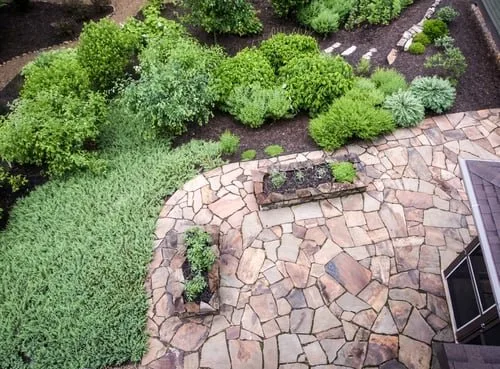
This is the question we get asked most often on a patio estimate, and the honest answer is that neither material is better. They fail differently, they age differently, and they suit different ground. Anyone who gives you a blanket answer without walking your yard first is selling you whatever they happen to be good at.
Stamped concrete is one continuous slab, coloured and textured to imitate stone, slate, brick, or timber. Its great advantage in a climate like ours is that it is monolithic: there are no joints for weeds to grow through, no individual units to shift out of level, and nothing for moss to colonise the way it colonises everything else in this city. You pressure wash it once a year and it looks the way it did when it was poured. Its great disadvantage is that when it does crack, and eventually it will, the crack runs through the pattern and there is no invisible fix. You can repair and re-colour it, and a good crew can make that repair genuinely hard to spot, but it will never be a swap-one-piece job.
Pavers are the opposite trade-off. They are individual units laid on a compacted base and locked together by edge restraint and polymeric sand in the joints. Because the field is made of small pieces, it flexes with minor ground movement instead of cracking — which is a real advantage on soft delta soil in Richmond or on ground that heaves slightly with the seasons. If one paver sinks, cracks, or gets stained by a dropped can of paint, you lift it out and put a new one in. Nobody will ever know.
The cost of that flexibility is joints, and joints are where a wet climate goes to work on you. Weeds, moss, and washout all live in the joints. Polymeric sand controls this well when it is installed properly and set with the right amount of water, but it is not permanent — expect to re-sand a paver patio every few years, and expect to pull moss out of the joints in a shady north-facing yard on the North Shore whether you like it or not. Pavers are also more prone to creeping outward at the edges if the edge restraint was skimped on, which is the single most common paver failure we get called out to fix.
Now the part almost nobody mentions: for both materials, the base is what decides the outcome, and the base is identical work. Excavate to a real depth, lay and compact granular fill in lifts rather than dumping it all in at once, and grade the whole thing so water leaves the property. A stamped patio on a poor base cracks. A paver patio on a poor base sinks and goes wavy. The material you chose in the showroom is not what fails — the six inches of ground below it is. This is why a suspiciously cheap quote for either product is almost always a quote for a thin base, and why it will cost you the whole patio in five years.
In practice, here is how we advise. On stable ground with good drainage and a client who wants a large, seamless, low-maintenance surface — a big back patio, a pool surround, an entryway — stamped concrete usually wins, and it is normally the cheaper of the two per square foot. On soft, low-lying, or settlement-prone ground, and anywhere the client wants a surface they can lift and repair themselves, pavers usually win. On a driveway that will carry a heavy vehicle, both work, but the base gets deeper and the reinforcement gets more serious either way.
One last thing that matters in Vancouver specifically: whichever you choose, texture and sealer are safety features, not luxuries. A slick, over-sealed stamped patio is genuinely dangerous eight months of the year here. Ask for a slip-resistant sealer, and ask for it in writing. We build both, we sell neither harder than the other, and we will tell you on site which one your ground can actually carry.