
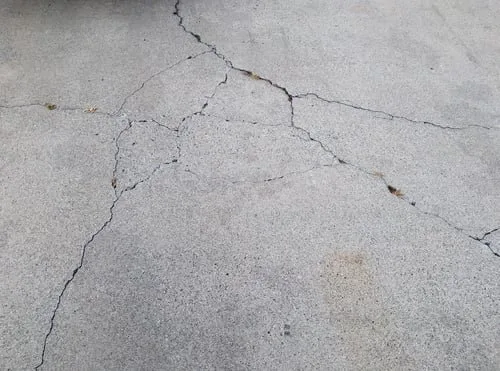
Concrete cracks. That is not a defect, it is chemistry. As a slab cures it loses water and shrinks, and because it is bonded to the ground underneath and cannot shrink freely, it relieves that tension the only way it can — by splitting. Any contractor who tells you your driveway will never crack is either inexperienced or hoping you will not still be paying attention in three years. What a good contractor actually controls is where the cracks go and how much they matter.
That is what control joints are for. Those straight lines cut or tooled into a new slab are not decoration; they are deliberate weak points that give the concrete a designated place to crack, below the surface, where you will never see it. Cut at the right depth (roughly a quarter of the slab thickness) and at the right spacing, they turn an ugly random crack into an invisible one. When we see a big open field of concrete with no joints in it, we already know what we are going to find.
So how do you tell a harmless crack from a serious one? Start with width. Hairline cracks you can barely fit a fingernail into are shrinkage cracks and are cosmetic. Cracks wider than about 3 mm are worth a look. The bigger tell is displacement: run your hand across the crack, and if one side sits higher than the other, that is not a concrete problem at all, that is a ground problem. The slab did not fail — the ground under one half of it moved, and the concrete simply followed it down.
In Metro Vancouver that ground movement has three usual suspects. In Richmond and the flat lowlands, the soil is river delta silt: soft, saturated, and prone to settling under any load that was not placed on a properly compacted base. On the slopes in Burnaby, New Westminster, and the North Shore, it is water moving downhill through the soil and washing out the material beneath the slab. And everywhere in the Lower Mainland, it is the freeze-thaw cycle: rain gets into a crack, freezes on one of our handful of cold nights, expands by roughly nine percent, and prises the crack wider. Then it rains again. Then it freezes again. That is how a hairline crack becomes a broken slab over a few winters.
Watch also for spalling — surface flaking that leaves the slab looking pockmarked and rough. That usually means water penetrated the surface and froze, or that the concrete was overworked or over-watered during the pour so that a weak, laitance-rich layer ended up on top. Spalling is a surface failure, not a structural one, but it is a fast track to a structural one because it gives water even more ways in.
The honest rule we use on site: hairline cracks get sealed to keep water out and left alone. Cracks with displacement, cracks that keep growing season to season, and slabs that have visibly sunk relative to a doorway or a garage floor do not get patched — because patching them does nothing about the ground that caused them, and you will be looking at the same crack again in two years. Those need the base addressed, and often the slab replaced.
If you have a crack you are unsure about, take a photo, mark the ends of it with a pencil, and check it again after the next stretch of heavy rain. If it has moved, call someone. We will come out, look at it, and tell you plainly whether you are looking at a repair or a replacement — and we would genuinely rather sell you the smaller job than take your money for a patch we know will fail.