
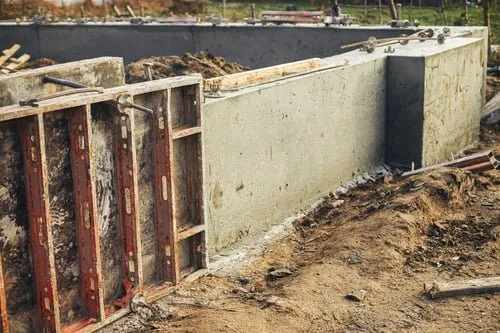
A retaining wall does one job: it holds back a mass of soil that would otherwise be somewhere else. On the hillsides of Burnaby, North and West Vancouver, Port Moody, and New Westminster, that mass is measured in tonnes, and it is pushing against the wall every second of every day. This is structural work. It is not garden edging, and the fact that a lot of walls in this region were built as though it were is why we spend so much of our year replacing them.
The number one cause of failure is not enough footing, or none at all. A wall needs a footing that is wider than the wall itself, and it needs to sit below the frost line on undisturbed or properly compacted ground. Set a wall on topsoil, or on a shallow footing that freezes, and the ground beneath it will move seasonally — heaving up and settling back — until the wall loses its plumb and starts to lean. Once it starts leaning, gravity is on the wall's side no longer, and the failure accelerates.
The number two cause, and honestly it might be number one, is drainage. Soil behind a wall soaks up rain. Saturated soil is far heavier than dry soil, and worse, the trapped water itself exerts hydrostatic pressure sideways against the back of the wall. In our climate the ground behind a wall is wet for a large part of the year. A wall built with no drainage rock and no weeping tile behind it is being asked to resist a force it was never designed for, and it will eventually bulge, crack, or tip. Every wall we build gets a free-draining rock backfill, a perforated pipe at the base, and a proper discharge point. Without those three things it is not a retaining wall, it is a delayed collapse.
The third cause is backfill placed carelessly. If the space behind a wall is filled by dumping soil in one go, it settles unevenly for years and loads the wall unpredictably. Backfill goes in in layers — lifts — each one compacted before the next goes on. It is slow, it is boring, and it is the difference between a wall that stays where you put it and a wall that develops a lean nobody can explain.
The fourth is simply the wrong wall for the load. Wall height and the slope above it determine the forces involved, and past a certain point that is a question for an engineer rather than a contractor's judgement. In most Metro Vancouver municipalities, walls above roughly 1.2 metres, walls carrying a surcharge like a driveway or a structure above them, and walls near a property line trigger permit and engineering requirements. We will tell you plainly when your wall is in that territory, and we will coordinate the engineering rather than guess — because a wall that fails on a slope does not fail quietly, and it does not fail alone.
So what does a properly built wall actually involve? Excavation back far enough to work and to place free-draining backfill. A compacted footing below the frost line. Reinforcement sized for the height. Drainage rock and weeping tile behind the full height of the wall, with an outlet that genuinely goes somewhere. Backfill compacted in lifts. Grade above the wall corrected so surface water does not simply pour over the top of it. Engineering and permits where the load calls for them.
That is more work, and it costs more, than the wall your neighbour got for a suspiciously good price. It is also why our walls are still plumb after the winters that took theirs out. If your existing wall is leaning, bulging, cracking in a stair-step pattern, or if the soil behind it is visibly slumping, do not wait for it to get worse — it will, and the ground it comes down with is the expensive part. Get someone to look at it while it is still a wall and not yet a landslide.