
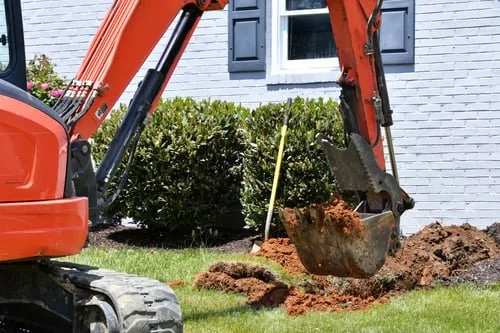
Metro Vancouver gets somewhere in the region of a metre and a half of rain a year, and the North Shore gets considerably more than that. That water has to go somewhere. If you have not decided where, the water decides for you — and what it decides is usually to sit against your foundation, soak into the ground under your slab, and quietly wash out the base that everything you own is sitting on.
This is why we look at grade before we look at anything else on an estimate. A patio or driveway needs a fall of roughly two percent — about a 2 cm drop over every metre — away from the house. That is a slope you barely notice underfoot and it is the difference between a surface that sheds water and a surface that ponds it. If you can see puddles standing on your concrete the morning after rain, the grade is wrong, and everything downstream of that fact is going to cost you eventually.
The mechanism is simple and it is relentless. Water pools on or beside the slab. It soaks into the granular base underneath. Saturated base material loses its bearing strength and compacts under load, so the slab settles. Water also gets into the surface pores and into any hairline cracks, and on the handful of nights each winter when the Lower Mainland actually drops below freezing, it expands and levers those cracks open. Add another wet season and the crack is wider, so more water gets in, so the next freeze does more damage. That feedback loop is what kills concrete here, and it starts with standing water.
Retaining walls are the same story with higher stakes. Saturated soil behind a wall does not just get heavy — it develops hydrostatic pressure, a genuinely enormous sideways force that no wall built without drainage can resist indefinitely. This is why every wall we build gets drainage rock behind it and a perforated weeping tile at the base with somewhere real to discharge to. It is invisible, it costs money, and it is the entire reason the wall is still standing in fifteen years. A wall built without it is not a cheaper wall, it is a wall with an expiry date.
Different parts of the region fail in different ways. In Port Coquitlam and other flat, low-lying areas, the water table sits high enough that yards genuinely hold standing water for days and there is nowhere obvious for it to run — those jobs need re-grading and often French drains before anything is built on top. In Richmond, on the delta, saturated silt settles under load, so the base has to be deeper and compacted harder than most contractors bother with. On the slopes of Burnaby, New West, and the North Shore, the problem is the opposite: water arrives fast and in volume, and if it is not given a defined path it will find one, usually straight underneath whatever you just paid for.
The fixes are not exotic. Correct the grade so water runs away from the house rather than towards it. Install French drains where the ground cannot shed water on its own. Extend downspouts so roof water is discharged away from the slab instead of onto it — a single downspout dumping onto the corner of a driveway will undermine that corner within a few years, and we see it constantly. Behind any wall, drainage rock and weeping tile, no exceptions. Keep catch basins and existing drains actually clear, because a blocked drain is the same as no drain.
The reason we lead with this rather than with concrete finishes is that it is the part that decides whether you pay once or pay twice. A beautiful new patio poured over ground that floods is a job we would rather turn down than take, because it buys you a few good years and then puts you exactly back where you started, only poorer. Sort the water first, and everything you build on top of it lasts.